Ensuring Climate Programs Work and Other News from Sen. Blakespear
Greetings!
The delicate balance between government regulation and the market economy is a central issue in Sacramento.
This concept took center stage in an oversight hearing of the California Air Resources Board (CARB) that I co‑chaired this week.
At issue are the rules that drive the state’s “cap and invest” program‚ namely how much leeway to give companies that create pollution in order to promote the goals of affordability and to protect existing California jobs.
You can watch the hearing here‚ which was led by the Senate Environmental Quality Committee and Senate Budget Subcommittee No. 2. I’m always trying to ground‑truth the information we receive from industry and from regulators.
Cap and invest is California’s landmark environmental program which requires major greenhouse gas emitters (i.e. oil refineries‚ cement plants‚ manufacturing) to pay to pollute‚ which both creates incentives to pollute less and also creates a fund of money to invest in programs that reduce pollution‚ improve public health‚ and encourage cleaner choices. The goal is to transition California to a cleaner‚ greener economy over time with a declining emissions cap.
Last year‚ the Legislature passed AB 1207 and SB 840 to update and extend the program. CARB heard loud and clear at the oversight hearing this week that the Legislature remains committed to meeting emissions reductions goals and that some parts of the proposal don’t seem to serve California’s residents.
Making Sure Those Who Need Mental Health Care Can Get It

To read the CalMatters story above‚ go here.
People struggling with serious mental illnesses who are living on the streets need to get care and treatment.
In 2023‚ the state established special court proceedings through the Community Assistance‚ Recovery‚ and Empowerment (CARE) Act‚ known as CARE Court‚ to help people with schizophrenia spectrum and other psychotic disorders. The court provides them with a comprehensive CARE plan that relies on public aid systems to deliver medication‚ services and housing. There are still many opportunities to improve the program so that those who need care‚ receive it.
I am pleased to report that two bills I have authored to help increase access to CARE Court or other avenues for treatment have passed the Senate Judiciary Committee.
SB 989 would improve access to CARE Court by authorizing first responders to request counties to review and file CARE Court petitions on their behalf‚ rather than requiring them to file directly with the court‚ which can be time‑consuming and complicated. First responders often encounter people with serious mental health problems‚ but don’t have the time or resources to file petitions for them to enter CARE Court.
SB 1016 would allow a judge to order a mental health evaluation when the severity of the mental health disorder exceeds the support that CARE Court can provide‚ clearing a pathway to appropriate treatment. As it is now‚ if a person can’t be served by CARE Court‚ that individual is simply dismissed from court.
We know there are many people with severe mental health problems who are living on the streets. Sadly‚ because they cannot get the help they need‚ they cycle through jails‚ homeless shelters‚ encampments‚ emergency rooms and community clinics. SB 989 and SB 1016 aim to help fix this.
Rail is in Crisis – and We Must Face Up to It

I recently spoke about the challenges facing rail at the California Passenger Rail Summit.
I’m a rail supporter‚ and I believe strongly in rail’s ability and potential to move millions of Californians efficiently in cities‚ and between cities‚ if we can make it more reliable.
Since being elected to the Senate in 2022‚ I have worked hard to support all passenger rail services in general and the LOSSAN rail corridor‚ in particular‚ which runs 351 miles from San Diego to San Luis Obispo.
Right now‚ we have a big problem. Our rail network is not delivering. Our rail network and operators all over the state are on the brink of collapse‚ have a backlog of capital needs‚ operations aren’t optimized to be fast and reliable – and we wonder why people choose their cars over a train.
Ridership hasn’t fully recovered from the pandemic‚ and now the finances are so bleak that many agencies are making cuts to service and staring at the possibility of financial insolvency making things even worse for the would‑be rider.
All year long‚ I have been calling on state leaders and stakeholders to step up with urgency. Across the board‚ we need to improve rail reliability‚ services and ridership. And we need a viable‚ long‑term‚ stable plan for funding.
Can we make passenger rail as successful in California as it is in the Northeast Corridor? I believe we can‚ eventually. But it’s going to take hard work and commitment‚ and making rail a higher priority.
Tour Highlights Importance of Wildlife Coexistence Efforts

To watch my video of the tour‚ visit my Instagram page.
Wildlife coexistence programs help our communities deter conflicts with wildlife‚ keep humans safe and allow animals to stay in the wild where they belong. This is especially important as wildfire and human development patterns force wildlife to forage in new and different areas‚ creating more interaction with Californians.
I recently had the pleasure of visiting the California Wolf Center and the San Diego Humane Society’s Project Wildlife to see how that works in our region. This year‚ I introduced SB 1135‚ to re‑establish a statewide wildlife coexistence program that ended in 2024 after three years when funding for it expired. Among other things‚ the program deployed trained regional human‑wildlife conflict staff around the state.
We need science‑based‚ situation‑specific‚ proactive strategies to minimize negative interactions and prevent escalation to conflicts that pose risks for people and animals. SB 1135 uses this approach to better protect people‚ wildlife and communities.
Fighting Tijuana River Pollution

On California Ocean Day‚ I was happy to talk about the progress we are making in addressing the Tijuana River Valley pollution problem with a group of advocates who support ocean protection.
For decades‚ the valley has seen an unmitigated flow from Mexico of raw sewage‚ toxic industrial chemicals and trash. Some of these flows travel through ocean currents to our coastline‚ which has closed beaches up the San Diego coast‚ harmed marine life and endangered public health.
This crisis has undermined everything we stand for as Californians by restricting access to our beloved recreational spaces‚ polluting our oceans and disrupting precious ecosystems.
Earlier this year at a roundtable meeting held by two federal agencies‚ federal officials said they were more engaged than ever in working with Mexico to stop the pollution.
At the state level‚ we’re doing what we can. State legislators and regulators have funneled resources toward prevention‚ mitigation and clean‑up efforts.
In the last five years‚ California has allocated tens of millions of dollars to address the poor water quality in the Tijuana River Valley and along the Southern California coast. We have secured an additional $46 million through Prop 4 bonds that will be shared between the Tijuana River Valley and the New River in Calexico.
Two of my San Diego County colleagues in the Legislature – Sen. Steve Padilla and Asm. David Alvarez – have worked tirelessly on this issue. They are pursuing legislation to allocate and accelerate funding to mitigation projects and create health‑based standards to serve the needs of the communities most impacted.
For my part‚ I have authored legislation – SB 1046 – to protect workers within the Tijuana River Valley‚ such as lifeguards and park rangers. The bill would set safety standards for workers‚ and make sure they have the safeguards they need.
Protecting California’s Coastline from Offshore Oil Drilling

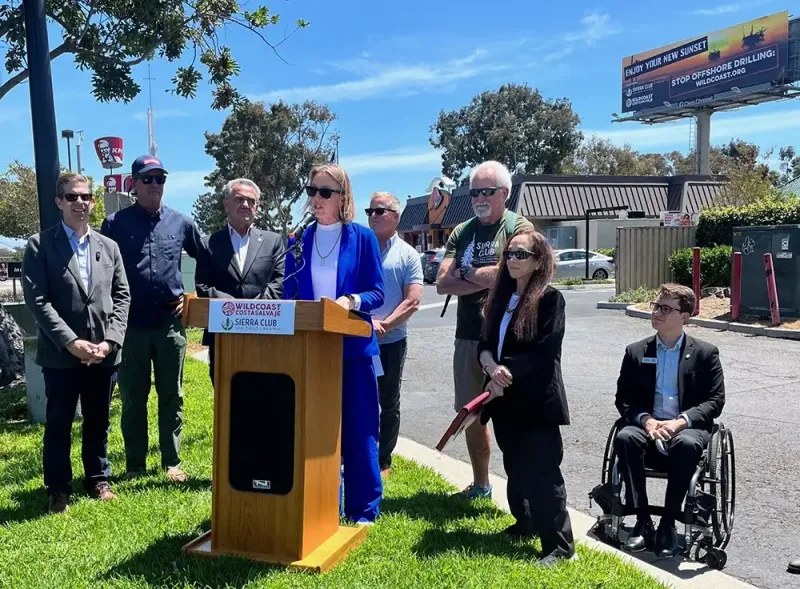
I recently joined with U.S. Rep. Mike Levin‚ San Diego City Council President Joe LaCava‚ WILDCOAST Executive Director Dr. Serge Dedina and other advocates at a press conference (photo above) to call on the federal administration to stop its plans for oil drilling off the coast of California. Notice the billboard in the background that was just erected to draw attention this this problem.
Put simply: The Trump administration’s plan to issue new leases for offshore drilling near California for the first time in 60 years is reckless‚ short‑sighted and irresponsible.
There is no reason to jeopardize California’s entire coast to double down on dirty fossil fuel production‚ when California is moving in the opposite direction‚ leading the world toward a clean energy future.
We know that when you drill‚ you spill‚ and that creates devastating environmental consequences‚ as we have seen repeatedly. In Santa Barbara in 1969‚ more than 3 million gallons of oil spilled into the ocean‚ killing more than 10‚000 seabirds‚ dolphins‚ seals and sea lions.
Thanks to WILDCOAST for leading a campaign of awareness with billboards and advertisements‚ so Californians know what is at stake.
Celebrating Genentech‚ and Biotech‚ Turning 50

I was glad to help celebrate and commemorate (photos above) the 50th birthday of biotech giant Genentech‚ which helped lead the modern biotech revolution.
Thanks to Genentech and many other companies like it based in California‚ the world is a much better place‚ and millions of people who once faced incurable diseases or debilitating physical ailments with little or no hope now have medicines or treatments.
Today‚ the life science industry is California’s second largest industry‚ and it help fuels the state’s innovation economy‚ especially in San Diego County‚ one of the nation’s leading life science clusters.
I recently presented‚ and the Senate passed‚ Senate Resolution 88‚ which recognizes the birth and growth of the California life science industry over the past 50 years and its phenomenal impact. You can watch my presentation here.
Winning Competitive Lemon Picking!

My volunteer team from District 38 won the 4th annual competitive lemon picking event known as a “Glean‑A‑Thon!” ProduceGood (photos above) and 60 volunteers picked lemons as fast as possible for an hour. The fruit is donated to families struggling to put food on the table. (Watch my video of the event on my Instagram page.)
ProduceGood has been fighting hunger in San Diego County since 2014. The organization recruits backyard growers‚ farmer markets and grocery retailers to create an outlet for surplus produce that feeds the hungry.
It organizes events and recruits volunteers to glean‚ which is the process of collecting leftover crops after they have been commercially harvested or when it is not economically profitable to harvest. It then provides the produce to the San Diego Food Bank and other organizations serving families that are food insecure.
I am so impressed with what ProduceGood does that not only do I make it a point to participate in their events‚ I also honored it as Senate District 38 Nonprofit of the Year in 2024. I’m grateful for ProduceGood’s continued leadership and service.
Check out opportunities to pick fruit and help those in need! It’s a great way to volunteer.
Thank you for your support. I am honored to serve you.
In partnership‚